
The Coffey still was patented in 1831, and it solved a problem that had occupied distillers for centuries: how to produce large volumes of high-purity spirit continuously, without the labour and inefficiency of batch distillation. The column still — or continuous still, or patent still — that Aeneas Coffey designed is, in its essential principles, the piece of equipment that produces most of the vodka consumed in the world today. It has been refined enormously since 1831. It has not been superseded.
Understanding how different distillation approaches shape vodka requires understanding what distillation is actually doing, and why the method chosen determines the character of the result.
What Distillation Does
Distillation is separation by selective evaporation. Alcohol evaporates at a lower temperature than water (78.4°C versus 100°C at standard pressure), which means heating a fermented wash produces a vapour richer in alcohol than the liquid it came from. Collect and condense that vapour and you have a spirit. Repeat the process with that spirit and you have a purer one.
The complication is that the fermented wash contains not just ethanol and water but hundreds of other volatile compounds — congeners — with boiling points distributed across a range. The distiller's task is to collect the ethanol-rich fraction (the "heart cut") while separating it from the heads (early-run compounds that include harsh aldehydes) and tails (late-run heavier alcohols and fatty acids). Every distillation decision — still type, number of passes, cut points, temperature management — is a decision about which congeners to keep and which to eliminate.
Column Distillation
The column still achieves continuous, highly efficient separation in a single apparatus. The fermented wash enters near the top of a tall column and falls through a series of perforated plates. Steam rises from below, vapourising the alcohol as it meets the descending liquid. The alcohol vapour rises, contacts cooler liquid on higher plates, and partially condenses and re-evaporates repeatedly — achieving the equivalent of many distillation passes in a single run.
Column distillation produces high-purity spirit efficiently and at scale. It is the method used by Absolut, Grey Goose, and the vast majority of commercial vodka producers. The purity it achieves is its primary virtue — and, in the view of craft producers who have moved away from it, its primary limitation.
Pot Distillation
The copper pot still is the oldest distillation technology in continuous use. It operates in batches: fill the pot with wash, heat, collect the vapour, discard the heads and tails, collect the heart. Pot distillation is slower, more labour-intensive, and less efficient in yield terms than column distillation. It is also less aggressive in congener removal — the heart cut retains more of the base ingredient's character.
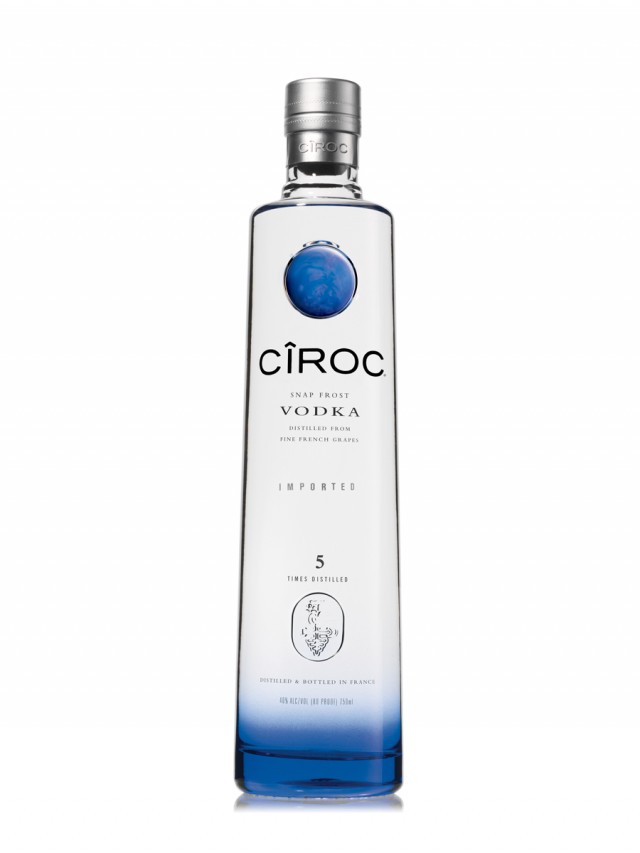
Ciroc is the most prominent example of a luxury vodka produced using pot distillation. The Ugni Blanc and Mauzac Blanc grape spirit is distilled five times in copper pot stills — an unusually high number of passes for a pot still operation, designed to achieve purity while preserving the grape's delicate floral and fruity character. The result is demonstrably distinct from column-distilled grain vodka.
Hybrid Approaches
Ketel One uses a hybrid method — continuous column distillation followed by pot still finishing — that deliberately combines the consistency of column distillation with the character-preserving quality of pot still work. This approach is intellectually honest about what each method contributes and produces a spirit that is both reliable and interesting. It is the middle path, and in the context of vodka production, it represents a genuinely thoughtful aesthetic position.
The distillation method does not determine quality in any simple linear sense. It determines character. A badly made pot still vodka is worse than a well-made column still vodka. The method sets the range of possibilities; the distiller's craft determines where within that range the finished spirit lands.